
Key Takeaways
- A midrange bathroom remodel returns about 61% of its cost at resale in the Greenville, SC market.
- Shower-focused projects tend to beat that average because they cost far less than a full gut while changing the room’s entire impression.
- Resale return is only one of three payoffs — avoided maintenance and avoided water damage are the other two.
- Overbuilding past neighborhood norms is the most reliable way to destroy ROI.
- A dated or failing shower is the most common item flagged in inspection and the most common thing buyers negotiate against.
- Documentation — warranty paperwork and photos — is part of the return. Undocumented work is discounted work.
The 61% figure, in context
Cost vs. Value data for the Greenville, SC market shows a midrange bathroom remodel recouping approximately 61% of its cost at resale. That number does two useful things: it sets a realistic expectation, and it puts bathrooms near the top of the interior-project list.
It also gets misread constantly. A 61% return does not mean you lost 39%. It means that after years of using a bathroom you actually like, the market hands most of the money back when you sell. Very few things you spend money on in a home do that. A vacation returns nothing. A new car returns a fraction and depreciates on the way home. A bathroom returns most of it and you shower in it every day in the meantime.
Why shower projects outperform the average
The 61% figure describes a full midrange remodel — flooring, vanity, toilet, lighting, and the shower. ROI is a ratio, and a shower-focused project attacks it from the favorable side: it delivers most of the perceived transformation at a fraction of the cost.
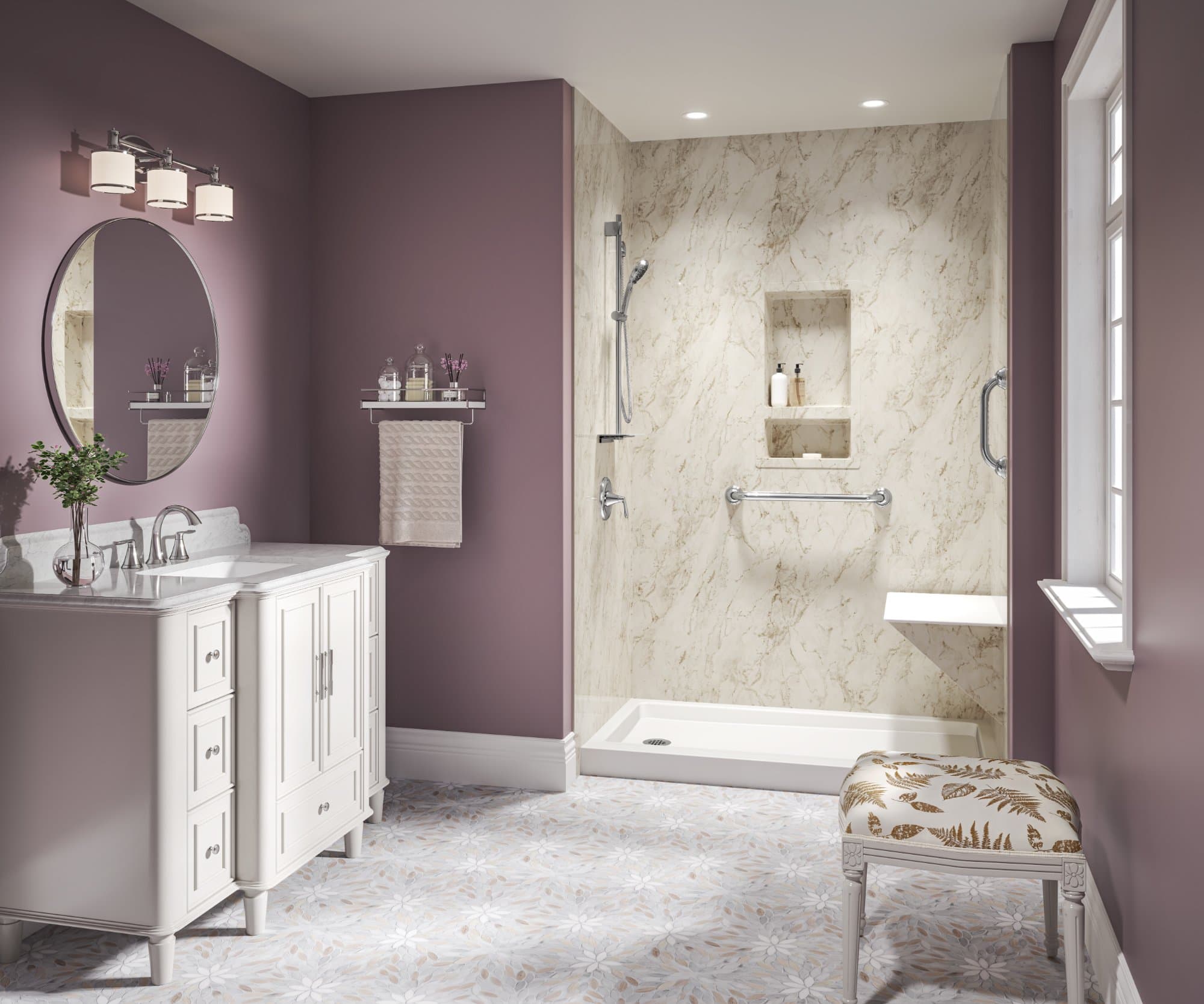
Walk into a bathroom with a dated fiberglass surround or a stained-grout tile shower and the whole room reads as old, regardless of the vanity. Replace that one element and the entire room reads as renovated. Buyers respond to the shower first because it is the largest visual surface in the room and the thing they picture themselves using.
| Project | Relative cost | Perceived impact on the room | Time out of service |
|---|---|---|---|
| Full midrange bathroom remodel | Highest | Complete | 3–6 weeks |
| Walk-in shower replacement | Moderate | Very high | As little as 1 day |
| Tub-to-shower conversion | Moderate | Very high | As little as 1 day |
| Tub & shower replacement | Moderate | High | As little as 1 day |
| Vanity and fixtures only | Low | Low — dated shower still dominates | Days |
Ready to Get Started?
Build Your Dream Bathroom
Schedule your free in-home design appointment today. We'll measure your space, show you every option, and give you an exact price — no surprises, no pressure.
- Free in-home design consultation
- No interest, no payments until 2027
- Lifetime warranty on every installation
Prefer to talk? Call (864) 685-7691
Schedule Your Free Appointment
No obligation. Just options.
What buyers actually notice
Return on investment in a bathroom is mostly a story about what a buyer concludes in the eight seconds they stand in the doorway. Those conclusions are predictable.
- Stained or dark grout reads as “not clean,” regardless of how clean it actually is. It is the number one thing that makes a bathroom feel old.
- A yellowed or crazed fiberglass surround reads as “this needs replacing,” and buyers mentally deduct a full replacement cost — usually more than it would have cost you.
- Mismatched fixture finishes read as deferred maintenance, even when everything works.
- A tub nobody would use in a primary bath reads as wasted space to most buyers under 50.
- A clean, modern walk-in shower reads as “this house has been taken care of,” and that impression carries into rooms the buyer has not seen yet.
This is why a shower replacement punches above its cost. It is not just a fixture — it is the piece of evidence buyers use to judge how the whole house has been maintained.
The three ways a bathroom remodel pays you back
1. Resale value
The visible return — roughly 61% of cost in this market. Worth noting: it is not only a price effect. Homes with updated bathrooms tend to move faster, and days-on-market has its own carrying cost in mortgage payments, taxes, insurance, and utilities on a house you no longer want.
2. Avoided maintenance
This one never shows up in a Cost vs. Value report. A tile shower carries a permanent maintenance schedule: resealing grout every year or two, regrouting every five to ten, replacing cracked tile, and fighting mildew in porous seams. A non-porous acrylic system with a limited lifetime warranty removes that line item from your life entirely. Over twenty years, that is real money and a lot of Saturdays. Our maintenance guide covers what each material actually demands.
3. Avoided water damage
The largest and least predictable return. When a shower leaks through failed grout into the wall cavity, the repair is not a shower repair — it is framing, subfloor, drywall, sometimes the ceiling of the room below. Replacing a failing shower before that happens is insurance you can see. This is why we inspect the substrate on every job and show homeowners photos of what is behind the old walls.
How to maximize your return
- Fix the shower first. It is the largest surface in the room and the element buyers judge the room by.
- Do not overbuild for the neighborhood. A $30,000 primary bath in a neighborhood of $325,000 homes will not come back. Match the block.
- Choose materials with a warranty. “Lifetime limited warranty” is a line an agent can put in a listing. “Regrouted last spring” is not.
- Keep at least one tub in the home. Convert a second or third bath freely; think twice about the only tub if you are selling soon.
- Add accessibility features that look like design. Low-threshold entry, a fold-down bench, and decorative-finish grab bars widen your buyer pool without making the room look clinical. See our aging-in-place guide.
- Keep the documentation. Warranty paperwork, permits where applicable, and photos of the completed work all support your asking price.
- Choose finishes with a long shelf life. Trend-chasing dates a bathroom fast. Neutral walls with expressive fixtures age better than the reverse — more in our design guide.
Frequently Asked Questions
What is the ROI on a bathroom remodel?
Cost vs. Value data for the Greenville, SC market shows a midrange bathroom remodel returning approximately 61% of its cost at resale, which places bathrooms among the stronger interior remodeling investments. Shower-focused projects such as walk-in shower replacements and tub-to-shower conversions often perform better than that average, because they deliver most of the room’s visual transformation at a fraction of a full remodel’s cost.
Does a new shower increase home value?
Yes. The shower is the largest visual surface in most bathrooms and the element buyers use to judge whether the room is updated. A dated fiberglass surround or a stained-grout tile shower makes an entire bathroom read as old, while a new walk-in shower makes the same room read as renovated.
Is a bathroom remodel worth it if I am not selling?
Often more so. Resale is only one of three returns. The other two — eliminating ongoing grout sealing and regrouting, and preventing hidden water damage to studs and subfloor — accrue to you every year you live in the home, and neither appears in a Cost vs. Value report.
Which bathroom upgrade has the best ROI?
Replacing a dated or failing shower. It costs far less than a full gut renovation, changes the room’s entire impression, and removes the item most likely to be flagged in a home inspection. Vanity and fixture updates have far less effect when a dated shower still dominates the room.
How much does a bathroom remodel cost in Greenville, SC?
The national average of a bathroom remodel as of 2025 is over $25,000. Patriot Showers focuses on the bath or shower wet area and provides exact project pricing only after an in-home measurement and design consultation. Financing options are available subject to approval.
Can I overspend on a bathroom remodel?
Yes. The most reliable way to reduce ROI is to build well beyond the norms of your neighborhood. A remodel priced far above comparable homes on your street will not return proportionally at resale. Matching the quality level of your market is the safer strategy.
Do I need to keep receipts and warranty paperwork?
Yes. Documentation is part of the return. Warranty documents, any required permits, and before-and-after photos let a listing agent describe the work specifically rather than generically, and they reassure buyers and inspectors that the work was done properly rather than patched.
