
Key Takeaways
- For homeowners prioritizing easy cleaning and no grout resealing, 100% virgin acrylic is a strong option with non-porous, grout-free surfaces and limited lifetime manufacturer coverage on qualifying products.
- Judge a material on five criteria: waterproofing, maintenance, durability, safety, and warranty. Appearance is the easy part.
- Fiberglass is the cheapest and the shortest-lived. Natural stone is the most expensive and the highest-maintenance.
- Tile’s weak point is grout, not tile. Every porous seam is a potential path to the studs.
- Humidity matters: in the Upstate, porous materials stay damp longer, which accelerates every failure mode.
- A custom-measured acrylic system can be installed in as little as one day and qualifying BathWraps acrylic products include limited lifetime manufacturer coverage.
How to judge a shower wall material
Showrooms sell on appearance. Bathrooms are won or lost on five other things:
- Waterproofing. Is the surface itself the barrier, or does it rely on something hidden behind it?
- Maintenance. What will you be doing every week, every year, and every decade to keep it right?
- Durability. How does it look in year fifteen, not year one?
- Safety. Slip resistance, and whether the system supports grab bars and seating.
- Warranty. What is actually covered, for how long, and by whom?
A material that scores well on all five will still be a good decision a decade from now. A material that only scores on appearance becomes a project you have to redo.
The local variable: humidity
Upstate South Carolina summers are humid, and bathrooms here dry out more slowly between uses than they do in a dry climate. Everything that goes wrong with a porous surface — mildew colonizing grout, sealer breaking down, stone absorbing and staining — happens faster when the surface stays damp longer. It is a real reason the material calculus in Greenville differs from the same decision in Denver.
The six materials, compared
| Material | Waterproof | Maintenance | Typical lifespan | Warranty | Relative cost |
|---|---|---|---|---|---|
| 100% virgin acrylic | Non-porous, fully waterproof | Wipe clean | Decades | Limited lifetime | Moderate |
| Solid surface | Non-porous | Low; can be refinished | Decades | Limited | High |
| Porcelain / ceramic tile | Tile yes, grout no | Seal every 1–2 yrs; regrout 5–10 yrs | 15–25 yrs (grout sooner) | None on grout | High |
| Cultured marble | Gel-coated surface | Polishing; avoid abrasives | 15–20 yrs | Limited | Moderate–High |
| Natural stone | Porous — must be sealed | Frequent sealing; etches and stains | Varies widely | None on installation | Very high |
| Fiberglass | Gel coat over porous matting | Yellows and dulls; cracks | 10–15 yrs | Short-term | Low |
Ready to Get Started?
Build Your Dream Bathroom
Schedule your free in-home design appointment today. We'll measure your space, show you every option, and give you an exact price — no surprises, no pressure.
- Free in-home design consultation
- No interest, no payments until 2027
- Lifetime warranty on every installation
Prefer to talk? Call (864) 685-7691
Schedule Your Free Appointment
No obligation. Just options.
A closer look at each option
100% virgin acrylic — best overall
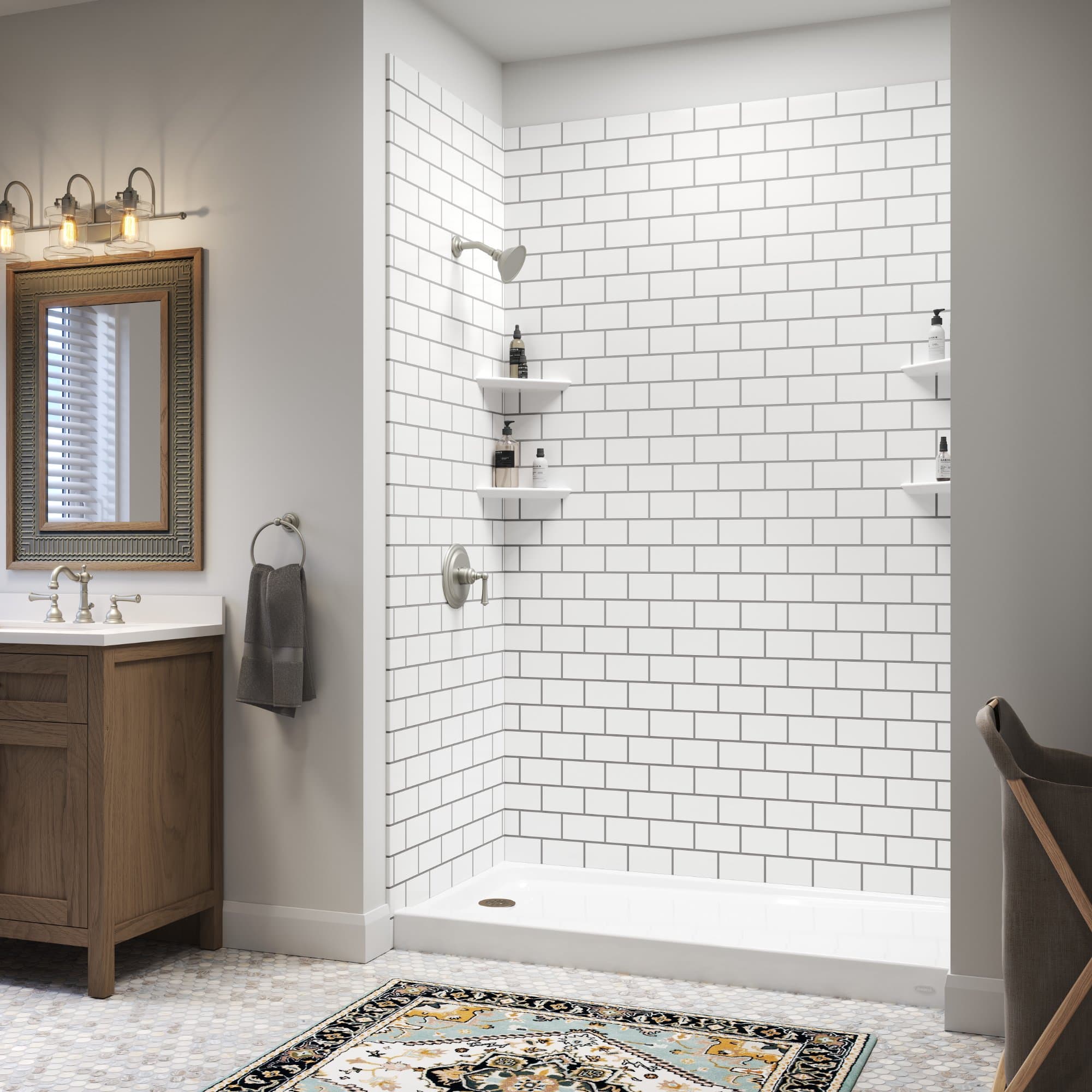
Manufactured from new resin with no regrind, non-porous through the full thickness, and custom-measured to your bathroom before install day. There is no grout, no sealer, and no porous substrate for mildew to reach. It supports grab bars and fold-down seating, comes in slip-resistant base textures, and is offered in patterns that replicate marble, slate, subway tile, shiplap, and travertine. Installed in as little as one day, with a limited lifetime warranty on BathWraps products. For homeowners who want easy-to-clean, safe, durable, beautiful, and affordable in one material, this is the answer.
Acrylic covers the overwhelming majority of real bathrooms — alcoves, corners, neo-angles, and oversized showers are all custom-measured to fit. The one project it is not built for is a fully custom architectural shape, such as a curbless wet-room floor or an irregular footprint, where tile is the more flexible material. Your designer will tell you which category your bathroom is in at the consultation.
Solid surface — excellent, at a premium
Non-porous, seamless, and refinishable if it is scratched. Genuinely good material. The drawback is cost — it typically prices above acrylic without a meaningful performance advantage in a shower, and it is heavy enough to complicate installation in some homes.
Porcelain and ceramic tile — beautiful, high-maintenance
Unlimited design flexibility and the right choice for custom geometry. But the tile is not the waterproofing layer — the membrane behind it is, and the porous grout in between absorbs water. Sealing every year or two, regrouting every five to ten, and the real possibility of hidden water damage are all part of the deal. Full comparison: acrylic vs. tile.
Cultured marble — dated but serviceable
A crushed-stone-and-resin composite under a gel coat. Fewer seams than tile and reasonably durable, but the gel coat can dull, yellow, and crack, and once it is compromised the composite beneath is exposed. Repairs are possible but rarely invisible.
Natural stone — the most expensive way to create work for yourself
Marble, travertine, and slate are porous. In a shower they must be sealed regularly, and they etch from ordinary bathroom products — shampoo, soap, anything acidic. Stunning in a powder room; a demanding, costly choice on a shower wall used daily. Installation carries no warranty.
Fiberglass — the budget option, and it shows
A thin gel coat over fiberglass matting. Inexpensive up front and common in homes built from the 1970s through the 1990s — which is why so many Upstate homeowners are replacing one right now. It yellows, dulls, flexes underfoot, and cracks. Once the gel coat wears through, the porous matting is exposed. Expect 10 to 15 years.
The best material for your specific priority
If one factor dominates your decision, here is where each lands.
| If your top priority is… | Choose | Why |
|---|---|---|
| Easiest cleaning | 100% virgin acrylic | No grout, no sealer, non-porous. Wipe and done. |
| Lowest lifetime cost | 100% virgin acrylic | No recurring maintenance, lifetime limited warranty. |
| Safety for aging in place | 100% virgin acrylic | Slip-resistant bases, supports anchored grab bars and seating. |
| Fastest installation | 100% virgin acrylic | As little as one day versus weeks. |
| Fully custom shape | Tile | The only material with unlimited geometry. |
| Lowest possible up-front price | Fiberglass | Cheapest today; usually replaced within 15 years. |
| A seamless, refinishable surface | Solid surface | Excellent performance at a premium price. |
The recommendation
For a frequently used bathroom, 100% virgin acrylic is a strong choice when easy cleaning, grout-free walls, custom fit, and warranty coverage are priorities. BathWraps combines non-porous wall material with a complete system, textured base options, and limited lifetime manufacturer coverage on qualifying acrylic products.
Once you have chosen a material, the next decisions are pattern, glass, finish, and storage. Those are covered in our shower design guide.
Frequently Asked Questions
What is the best material for shower walls?
For most homeowners, 100% virgin acrylic is the best shower wall material. It is non-porous and fully waterproof, has no grout to seal or scrub, resists mold and mildew, supports grab bars and slip-resistant bases, installs in as little as one day, and carries a limited lifetime warranty. Tile offers more design flexibility but relies on porous grout that requires ongoing maintenance and carries no lifetime warranty.
What is the easiest shower wall material to clean?
Acrylic and solid surface, because both are non-porous and grout-free. Cleaning is a non-abrasive cleaner and a soft cloth. Tile, natural stone, and cultured marble all require more effort — grout scrubbing, sealing, or polishing depending on the material.
What is the most durable shower wall material?
Non-porous materials last longest in a wet environment. 100% virgin acrylic and solid surface both routinely last decades. Fiberglass is the least durable at roughly 10 to 15 years, and tile installations usually outlive their grout, which needs replacing every five to ten years.
Are acrylic shower walls waterproof?
Yes. 100% virgin acrylic is non-porous through its full thickness, so the surface itself is the waterproof barrier rather than a membrane hidden behind it. There are no porous grout lines for water to pass through.
What shower wall material is safest for seniors?
Acrylic systems, because they combine a slip-resistant textured base, a low-threshold entry option, and wall construction that supports properly anchored grab bars and fold-down bench seating. Polished stone and glossy tile are the least slip-resistant options.
Does humidity affect which shower material I should choose?
Yes. In humid climates like Upstate South Carolina, bathrooms dry more slowly between uses, so porous surfaces stay damp longer. That accelerates mildew growth in grout, breakdown of stone sealers, and staining. Non-porous materials such as acrylic and solid surface are less affected because there is nothing for moisture to be absorbed into.
How much do acrylic shower walls cost?
The total project depends on existing conditions, preparation, base or tub, wall system, plumbing connections, glass, fixtures, and accessories. Patriot Showers provides an exact written price after measuring the bathroom and confirming selections during the free in-home consultation.
